By Dr. Amit Saxena
CEO, Sparsh Universe
The MBA has long been regarded as the passport to corporate leadership. For decades, it has equipped aspiring managers with frameworks, financial acumen, marketing strategies, and organizational insights. However, as Artificial Intelligence reshapes industries at an unprecedented pace, a fundamental question emerges:
Is the traditional MBA preparing leaders for yesterdayâÂÂs business world or tomorrowâÂÂs intelligent enterprises?
The AI era demands more than managers who understand businessâÂÂit requires leaders who can orchestrate the collaboration between human intelligence and artificial intelligence. The future belongs not to those who compete with AI, but to those who know how to lead with it.
The New Reality
AI is no longer a futuristic concept confined to research labs. It is writing reports, analyzing markets, designing products, optimizing supply chains, negotiating customer interactions, and even contributing to strategic decisions. Routine managerial work is increasingly becoming automated.
Ironically, while AI excels at processing information, organizations need humans who can provide judgment, ethics, creativity, empathy, and vision.
This shifts the role of management education dramatically.
From Learning Functions to Solving Problems
Business schools have traditionally organized education around functional silosâÂÂMarketing, Finance, HR, Operations, and Strategy.
The AI economy is dissolving these boundaries.
TomorrowâÂÂs leaders must solve multidisciplinary problems where technology, human behaviour, sustainability, governance, and global markets intersect. The curriculum should therefore revolve around real-world challenges rather than isolated academic subjects.
What Every MBA Graduate Must Learn
The next-generation MBA should integrate capabilities that were once considered optional:
- AI Literacy for Business Leaders
- Data-driven Decision Making
- Prompt Engineering and Human-AI Collaboration
- Digital Transformation Strategy
- Cybersecurity and Data Ethics
- Sustainability and ESG Leadership
- Entrepreneurial Thinking
- Systems Thinking
- Cross-cultural Leadership
- Emotional Intelligence and Human Skills
The future CEO will not necessarily be the best coder but will certainly be the best integrator of people, technology, and purpose.
The Classroom Must Become a Living Enterprise
Lectures alone cannot prepare students for AI-enabled organizations.
Business schools must become innovation ecosystems where students:
- Build AI-powered business models.
- Solve live corporate consulting assignments.
- Work with startups and industry mentors.
- Learn through simulations and digital twins.
- Collaborate across disciplines.
- Experiment, fail, iterate, and innovate.
Education must become immersive rather than instructional.
Faculty Must Evolve Too
The AI revolution is transforming educators as much as learners.
Faculty members can no longer remain content experts alone. They must become mentors, researchers, industry collaborators, and learning architects who guide students in asking better questions rather than merely delivering answers.
The future classroom will blend human mentorship with intelligent learning assistants powered by AI.
The Human Advantage
As machines become smarter, human qualities become more valuable.
Curiosity.
Integrity.
Empathy.
Purpose.
Ethical judgment.
Resilience.
Leadership.
These cannot be automated.
Business schools must therefore invest as much in character formation as in competency development.
Reimagining Business Schools
The institutions that thrive over the next decade will not simply teach managementâÂÂthey will create adaptive leaders capable of navigating ambiguity, leveraging intelligent technologies, and building organizations that are both profitable and purposeful.
At Sparsh Global Business School, we believe the future of management education lies in integrating AI with human values, global exposure with local relevance, and innovation with responsibility.
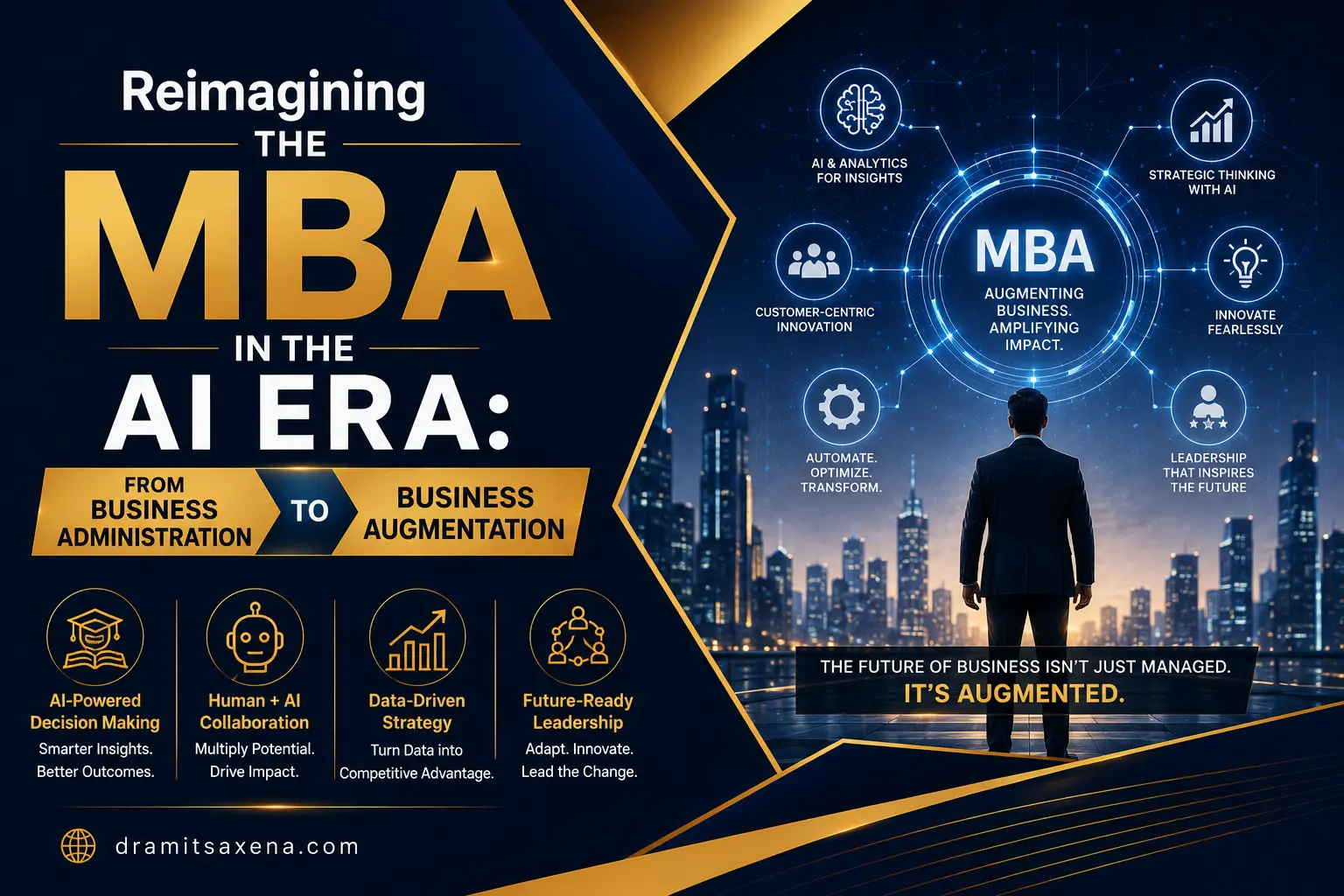
The MBA of the future is not about replacing human intelligence with artificial intelligence.
It is about augmenting human potential with intelligent technologies.
The question is no longer whether AI will transform management education.
The question is whether business schools are ready to transform themselves.
The future belongs to institutions courageous enough to redesign not just their curriculum, but their very philosophy of learning.